Putting a meaningful dent in your error backlog

“Let’s track our production errors,” they said. “We’ll harvest insights,” they said. And 3 years later, all we have to show for it is an error tracking dashboard so bloated with junk that it makes us sick to look at.

When error tracking is working, engineers engage with it regularly, scrutinizing every new error thrown. This regular engagement is what transmutes raw error data into meaning. If engagement ceases (or never gets started) then, like bull thistle in a sad old garden, noise dominates.

Of course we often don’t realize how noisy the errors have gotten until things are already well out of hand. After all, we’ve got shit to do. Deadlines to hit. By the time we decide to get serious about error management, a huge, impenetrable, meaningless backlog of errors has already accumulated. I call this stuff slag.

Slag is viscous. Try to dig yourself out of the heap by brute force, one error at a time, starting with the most common, and you won’t get very far. After you investigate the top 10 errors and find out that 9 of them are complete non-issues that aren’t worth fixing, the wind will drain from your sails. Investigating errors takes a lot of time, and there are still 340 to go! Wait, I just refreshed the page and there’s 348 now.

Slag engenders hopelessness, and hopelessness drives teams to declare bankruptcy on error tracking.

The reason slag engenders hopelessness is because you’d have to dig through essentially all the slag in order to get any value. But by excluding behaviors, you can create incremental value as you burn down the error list. This changes the tradeoff, making error remediation work into something that’s immediately and obviously worth doing.

The magic of excluded behaviors

Suppose you have a list of errors that your system throws in production. Sorting this list by frequency-of-error and eyeballing it, you see that it contains about:

  • 40 kinds of network timeouts
  • 30 different JSON parse errors
  • 20 Nil pointer exceptions, spread across the codebase
  • 12 Postgres deadlocks
  • … many more errors that are harder to lump into categories.

I would look at this list and say, “Well, deadlocks are never expected or desired, and they’re often contributing factors in larger problems… so let’s exclude deadlocks.” (Someone else, with different constraints and knowledge, might justifiably pick a different behavior to exclude.) Anyway, we pick a behavior, then we exclude it.

Here’s how you exclude a behavior:

  • List all the individual errors in the class to be excluded.
  • Burn down that list by fixing each underlying bug.
  • Create a (non-paging) monitor to catch regressions.

When you exclude a behavior, you get immediate incremental value. Where before there was a system that would sometimes deadlock in production, now there’s a system that is known never to deadlock in production.

This guarantee is immensely valuable. By eliminating deadlocks from the system, you block off a whole range of ways that surprising failure modes could creep into your system. This yields a direct increase in reliability.

Excluding a behavior also makes your system easier to troubleshoot! Suppose you’re hunting down a bug that manifests as sudden server process crashes in production. You might wonder if an out-of-memory condition could be to blame for this behavior. And so you might spend half a day scrolling through logs, trying to correlate OOM events with your crashes. Whereas, if you’ve excluded out-of-memory errors, then you can hop right over that whole entire rabbit hole. Haven’t been notified about any OOMs? Then there haven’t been any OOMs.

Here are some classes of behavior that you might choose to exclude:

  • deadlocks
  • out-of-memory crashes
  • network timeouts between load balancer and web server
  • 503 errors
  • Nil-pointer exceptions
  • database transactions longer than 30 seconds
  • Go panics

It shouldn’t be hard to think of more.

Do you really have to eliminate every member of an excluded class? Can’t you make exceptions?

Sure you can make exceptions. Just make sure you document the reasoning for any exception you make.

Because another great thing you get out of excluded behaviors is a list of known vulnerabilities to failure. This list is worth its weight in gold as a tool for knowledge transfer activities, such as onboarding, planning, and architecture design.

After a while, you get kind of addicted to excluding behaviors. Each new exclusion makes your production system that much more boring.

And boring is how we like ’em.

Outliers carry information. Don’t leave them on the table

Over a decade ago, I saw this talk by John Rauser. Only recently, though, did I come to realize how incredibly influential this talk has been on my career. Gosh what a great talk! You should watch it.

If you operate a complex system, like a SaaS app, you probably have a dashboard showing a few high-level metrics that summarize the system’s overall state. These metrics (“summary statistics”) are essential. They can reveal many kinds of gross changes (both gross “large scale” and gross “ick”) in the system’s state, over many different time scales. Very useful!

But don’t be misled. Summary statistics reveal certain patterns in the system’s behavior, but they are not identical to the system’s behavior. All summary statistics – yes, even distributions – hide information. They’re lossy. It’s easy to get lulled into the sense that, if an anomaly doesn’t show up in the summary statistics, it doesn’t matter. But a complex system’s behavior is not just curves on a plot. It’s a frothing, many-dimensional vector sum of instant-to-instant interactions.

When you investigate an anomaly in summary statistics, you’re faced with a small number of big facts. Average latency jumped by 20% at such-and-such time. Write IOPS doubled. API server queue depth started rising at some later time. Usually, you “zoom in” from there to find patterns that might explain these changes.

When you instead investigate a specific instance of anomalous behavior, you start with a large number of small facts. A request to such-and-such an endpoint with this-and-that parameter took however many seconds and crashed on line 99 of thing_doer.rb. None of these small facts tell you anything about the system’s overall behavior: this is just a single event among millions or billions or more. But, nevertheless: these small facts can be quite illuminating if you zoom out.

First of all, this probably isn’t the only time a crash like this has ever occurred. Maybe it’s happening multiple times a day. Maybe it happened twice as often this week as it did last week. Maybe it’s happening every time a specific customer makes a specific API request. Maybe that customer is fuming.

And second of all, the reason this event caught our eye in the first place was because it was anomalous. It had some extreme characteristic. Take, for example, a request that was served with very high latency. Perhaps, in the specific anomalous case before us, that extreme latency didn’t cause a problem. But how extreme could it get before it did cause a problem? If it took 20 seconds today, could it take 30 seconds next time? When it hits 30, it’ll time out and throw an error. Or, if multiple requests like this all arrived at the same time, could they exhaust some resource and interfere with other requests?

If the only anomalies you investigate are those that show up in summary statistics, then you’ll only find problems that have already gotten bad enough to move those needles. But if you dig into specific instances of anomalous behavior – “outliers” – then you can often find problems earlier, before they become crises.

Fix tomorrow’s problems by fixing today’s problems

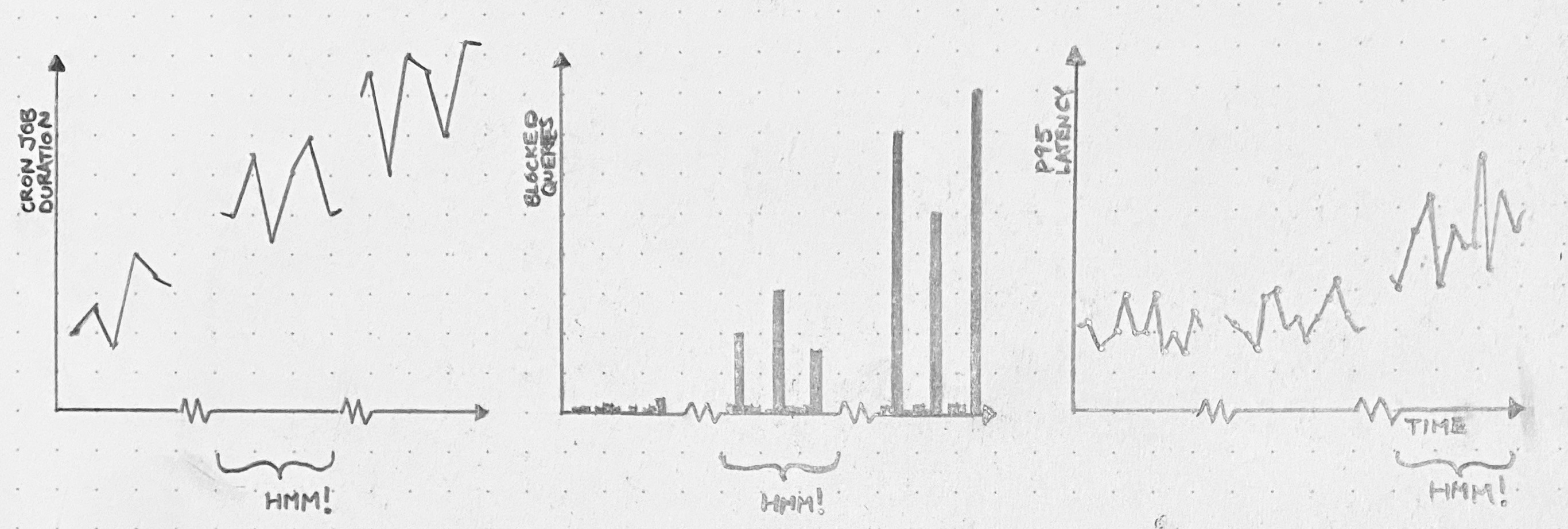
A bug in our deployment system causes O(N²) latency with respect to the number of deploys that have been performed. At first, it’s too minuscule to notice. But the average deploy latency grows over time. Eventually, deploys start randomly timing out. The deploy pipeline grinds to a halt, and it becomes an emergency.

Or maybe, if we think critically about the deploy latency time series soon enough, it might be obvious well in advance that something’s getting worse. We can fix this problem before it becomes a crisis. But in order to see it, we have to look. And we have to give ourselves time to go down the rabbit hole.

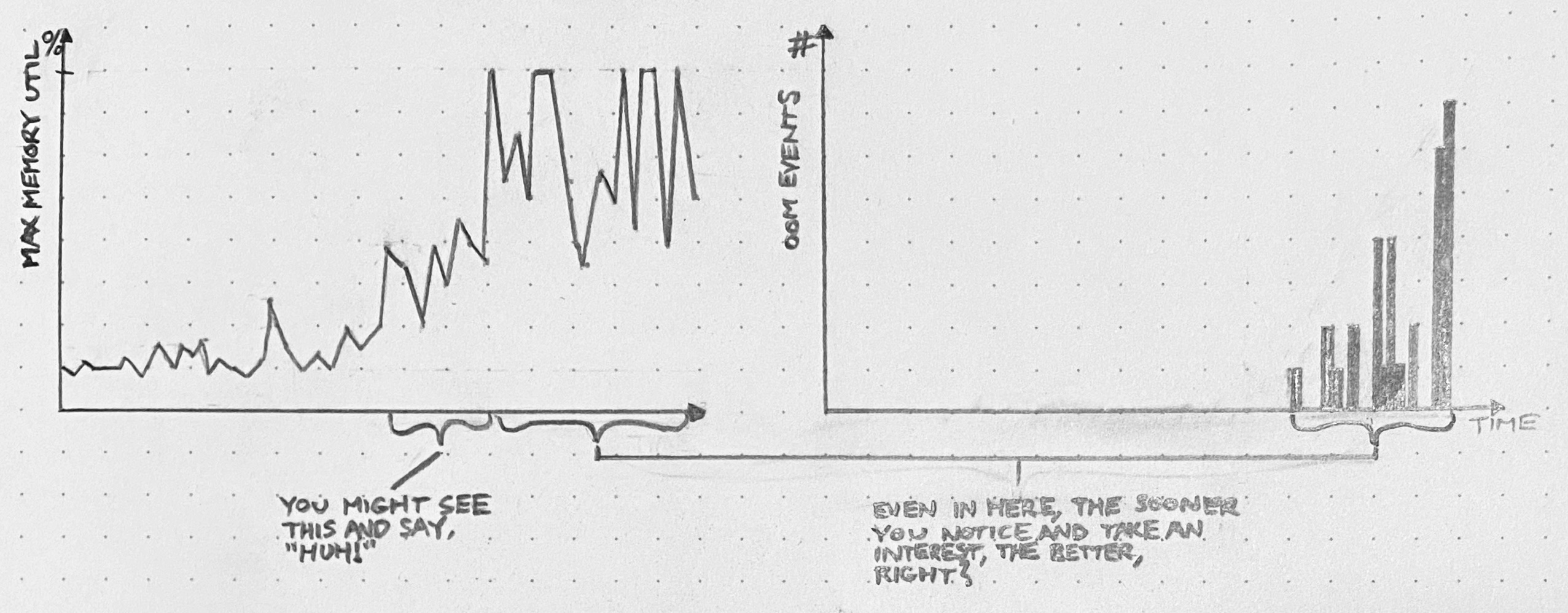
An API server has an edge case that leads to unconstrained memory usage. At first, this edge case only gets hit occasionally, and the API server’s memory usage stays well below capacity. But, as usage patterns evolve, we start to hit this bug more frequently, with larger and larger allocations of memory. For a while, we’re still below the OOMkill threshold. Once we start hitting that threshold, things get ugly. If we still continue to ignore it, then eventually, things will get so ugly that we’ll have to drop what we’re doing and fix this bug.

We had opportunities to see this coming. Depending on our willingness to dig in and investigate surprising phenomena, we could have discovered this problem when the OOMkills started, or even before they started – when these blips were just spikes on a memory graph.

A cron job runs every 30 minutes, and while it runs, it holds a database lock. When it’s first deployed, the cron job doesn’t have much to do, so it runs fast, and no one suffers. Over months, though, the cron job grows sluggish. It just has more work to do. Query pileups start to occur every 30 minutes. We start seeing significant impact on the latency of our application. And, one day, there’s an outage.

We’ll wish we’d dug in back when it was just a slow cron job. Or even when it was just query spikes.

You can prevent many things from turning into fires, but you need space. Space to be curious, to investigate, to explain your findings to yourself and others.

Suppose you spent a week looking for trouble like this, and you only happened to find 1 issue out of these 3. That’s still great, right? Compared to the cost of letting it become a disruption later?

When a system fails, it’s silly to blame practitioners for not seeing the signs. But that doesn’t mean we shouldn’t put in a serious effort to see the signs. If you give yourself space to follow the Huh!, you get opportunities to fix problems before they get worse.

Huh! as a signal

Every time our system fails, and we go to analyze the failure, we find ourselves saying things like “We didn’t know X was happening,” “we didn’t know Y could happen,” and so on. And it’s true: we didn’t know those things.

We can never predict with certainty what the next system failure will be. But we can predict, because painful experience has taught us, that some or all of the causes of that failure will be surprising.

We can use that!

When we go looking at data (and by “data” I mostly mean logs, traces, metrics, and so on, but data can be many things), sometimes we see something weird, and we go like, Huh!. That Huh! is a signal. If we follow that Huh! – get to the bottom of it, figure it out, make it not surprising anymore – two things happen. First, we get a chance to correct a latent problem which might some day contribute to a failure. And second, we make our mental model that much better.

Of course, any individual Huh! could turn out to be nothing. Perhaps there’s a bug. Perhaps circumstances have shifted, and our expectations no longer line up with reality. Or perhaps it’s just a monitoring blip. We won’t know until we run it down.

But, whatever the shortcomings of any particular investigation, a habit of investigating surprises has many attractive qualities. The main one is that we get to fix problems before those problems get worse, start bouncing off other problems, and cause fires. In other words: our system runs smoother. Consider what that’s worth.

Descriptive engineering: not just for post-mortems

In an organization that delivers a software service, almost all R&D time goes toward building stuff. We figure out what the customer needs, we decide how to represent their need as software, and we proceed to build that software. After we repeat this cycle enough times, we find that we’ve accidentally ended up with a complex system.

Inevitably, by virtue of its complexity, the system exhibits behaviors that we didn’t design. These behaviors are surprises, or – often – problems. Slowdowns, race conditions, crashes, and so on. Things that we, as the designers, didn’t anticipate, either because we failed to consider the full range of potential interactions between system components, or because the system was exposed to novel and unpredictable inputs (i.e. traffic patterns). Surprises emerge continuously, and most couldn’t have been predicted a priori from knowledge of the system’s design.

R&D teams, therefore, must practice 2 distinct flavors of engineering. Prescriptive engineering is when you say, “What are we going to build, and how?”, and then you execute your plan. Teams with strong prescriptive engineering capabilities can deliver high-quality features fast. And that is, of course, indispensable.

But prescriptive engineering is not enough. As surprises emerge, we need to spot them, understand them, and explain them. We need to practice descriptive engineering.

Descriptive engineering is usually an afterthought

Most engineers rarely engage with production surprises.

We’re called upon to exercise descriptive engineering only in the wake of a catastrophe or a near-catastrophe. Catastrophic events bring attention to the ways in which our expectations about the system’s behavior have fallen short. We’re asked to figure out what went wrong and make sure it doesn’t happen again. And, when that’s done, to put the issue behind us so we can get back to the real work.

In fact, descriptive engineering outside the context of a catastrophe is unheard of most places. Management tends to see all descriptive engineering as rework: a waste of time that could have been avoided had we just designed our system with more forethought in the first place.

On the contrary. To quote the late, lamented Dr. Richard Cook:

The complexity of these systems makes it impossible for them to run without multiple flaws being present. Because these [flaws] are individually insufficient to cause failure they are regarded as minor factors during operations. … The failures change constantly because of changing technology, work organization, and efforts to eradicate failures.

How Complex Systems Fail, #4

A complex system’s problems are constantly shifting, recombining, and popping into and out of existence. Therefore, descriptive engineering – far from rework – is a fundamental necessity. Over time, the behavior of the system diverges more and more from our expectations. Descriptive engineering is how we bring our expectations back in line with reality.

In other words: our understanding of a complex system is subject to constant entropic decay, and descriptive engineering closes an anti-entropy feedback loop.

Where descriptive engineering lives

Descriptive engineering is the anti-entropy that keeps our shared mental model of the system from diverging too far from reality. As such, no organization would get very far without exercising some form of it.

But, since descriptive engineering effort is so often perceived as waste, it rarely develops a nucleus. Instead, it arises in a panic, proceeds in a hurry, and gets abandoned half-done. It comes in many forms, including:

  • handling support tickets
  • incident response
  • debugging a broken deploy
  • performance analysis

In sum: the contexts in which we do descriptive engineering tend to be those in which something is broken and needs to be fixed. The understanding is subservient to the fix, and once the fix is deployed, there’s no longer a need for descriptive engineering.

Moreover, since descriptive engineering usually calls for knowledge of the moment-to-moment interactions between subsystems in production, and between the overall system and the outside world, this work has a habit of being siphoned away from developers toward operators. This siphoning effect is self-reinforcing: the team that most often practices descriptive engineering will become the team with the most skill at it, so they’ll get assigned more of it.

This is a shame. By adopting the attitude that descriptive engineering need only occur in response to catastrophe, we deny ourselves opportunities to address surprises before they blow up. We’re stuck waiting for random, high-profile failures to shock us into action.

What else can we do?

Instead of doing descriptive engineering only in response to failures, we must make it an everyday practice. To quote Dr. Cook again,

Overt catastrophic failure occurs when small, apparently innocuous failures join to create opportunity for a systemic accident. Each of these small failures is necessary to cause catastrophe but only the combination is sufficient to permit failure. Put another way, there are many more failure opportunities than overt system accidents.

How Complex Systems Fail, #3

We won’t ever know in advance which of the many small failures latent in the system will align to create an accident. But if we cultivate an active and constant descriptive engineering practice, we can try to make smart bets and fix small problems before they align to cause big problems.

What would a proactive descriptive engineering practice look like, concretely? One can imagine it in many forms:

  • A dedicated team of SREs.
  • A permanent cross-functional team composed of engineers familiar with many different parts of the stack.
  • A cultural expectation that all engineers spend some amount of their time on descriptive engineering and share their results.
  • A permanent core team of SREs, joined by a rotating crew of other engineers. Incidentally, this describes the experimental team I’m currently leading IRL, which is called Production Engineering.

I have a strong preference for models that distribute descriptive engineering responsibility across many teams. If the raison d’être of descriptive engineering is to maintain parity between our expectations of system behavior and reality, then it makes sense to spread that activity as broadly as possible among the people whose expectations get encoded into the product.

In any case, however we organize the effort, the main activities of descriptive engineering will look much the same. We delve into the data to find surprises. We pick some of these surprises to investigate. We feed the result of our investigations back into development pipeline. And we do this over and over.

It may not always be glamorous, but it sure beats the never-ending breakdown.