Leading incidents when you’re junior

If you’re a junior engineer at a software company, you might be required to be on call for the systems your team owns. Which means you’ll eventually be called upon to lead an incident response. And since incidents don’t care what your org chart looks like, fate may place you in charge of your seniors; even your boss!

That’s a lot of pressure, and they certainly didn’t teach you how to do it in school. You’re still just learning the ropes, and now they expect you to be in charge? During an outage? And tell more senior engineers what to do? It seems wrong and unfair.

But let your inexperience be an advantage!

Incident lead is not a technical role

The incident lead is the person accountable for keeping the response effort moving swiftly forward. That involves a wide variety of activities, of which fixing the problem only represents a subset.

Just like the leader of any team, the incident lead’s main job is to keep all the participants on the same page – in other words, to maintain common ground. It’s common ground that allows a group of individuals to work together as more than just individuals. And you don’t need to be deeply versed in the tech to do that. You just need to ask questions.

Aim to understand the problem just enough to make pretty good decisions. Your decisions don’t have to be perfectly optimal. If the primary SME says something like,

It looks like maybe the Chargeover service is borked.

and you don’t know what the Chargeover service is or why it might be borked: speak up! The Primary SME is already deep in the problem space, so they often won’t think to explain what they mean. And chances are you’re not the only one on the call who needs an explanation. As incident lead, it’s up to you to get clarity – not just for yourself, but for the whole group.

As someone who’s new to the tech stack, you’re perfectly placed to ask fundamental questions. So ask. For example, you could ask:

  • What makes you say the Chargeover service is borked? Did you see a graph or logs or something?
  • I’m not familiar with the Chargeover service – what does it do?
  • Do you have a hypothesis yet about why it’s borked?

You won’t need to ask a bunch of questions right in a row. Usually one or two is sufficient to jolt an SME out of “fixing mode” and into “explaining mode.” Then you can draw out enough information to build your own sufficient understanding, and in the process, the whole call will get an improved, shared understanding by listening to your conversation. It will develop common ground.

How do you know when your understanding is sufficient? That’s a job for closed-loop communication. As soon as you think you can, repeat back in your own words the following:

  1. The symptoms
  2. The main hypothesis that the SME is entertaining to explain the symptoms
  3. Any other hypotheses in play
  4. What action(s) the SME is planning to take

If you say these things and the SME says, “Yup, that’s right,” then congratulations! You’ve successfully established common ground among incident responders. You’ve done a better, more valuable job than the vast majority of incident leads (even ones who are very experienced engineers). Because you asked fundamental questions and listened.

If you’re looking to raise your incident response game, my 3-part course Leading Incidents is just what you need.

Ask questions first, shoot later

One piece of common-sense advice that you often hear about incident response is,

Fix it first. Ask “why” later.

This chestnut is often deployed to combat what is perceived as excessive investigation. And like most common-sense advice, it’s approximately right in lots of situations. But it misses a crucial point, and at its worst, this attitude perpetuates failure.

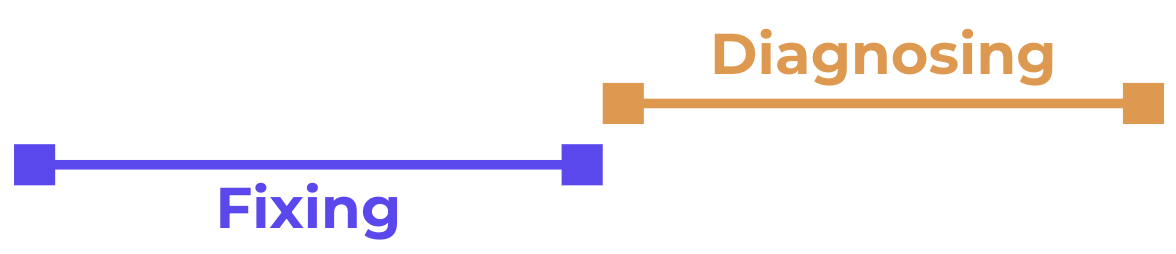
Diagnosing and fixing

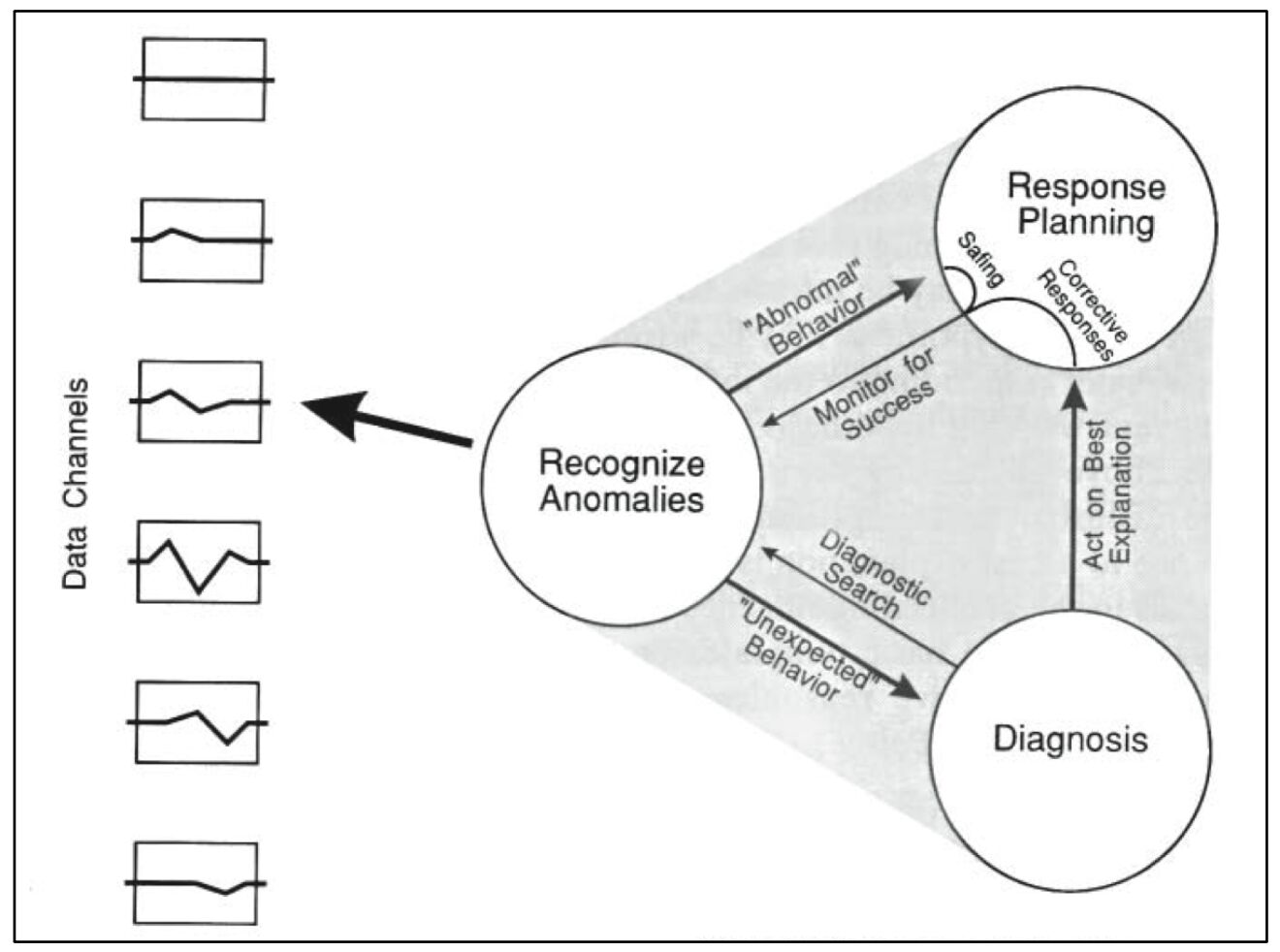
Incident response comprises two intertwined, but distinct, activities: diagnosing and fixing. This point is illustrated in David Woods’ 1995 paper, Cognitive demands and activities in dynamic fault management: abductive reasoning and disturbance management (which uses the term “response planning” for what I’m calling “fixing”):

Diagnosing and fixing can involve overlapping activities, such that they blend together during incident response. For example, if you have diagnosed a partial outage as resulting from a web server that’s used up all its allotted file handles, you might restart that web server. This would be a “diagnostic intervention,” in that it serves to advance both the fix (if your diagnosis holds water, then restarting the web server will fix the problem) and the diagnosis (if restarting the web server fixes the problem, then you have additional evidence for your diagnosis; if it doesn’t, then you know you need a new diagnosis).

The fact that fixing and diagnosing often converge to the same actions doesn’t change the fact that these two concurrent activities have different goals. The goal of fixing is to bring the system into line with your mental model of how it’s supposed to function. The goal of diagnosing is to bring your mental model into line with the way the system is actually behaving.

Usually these two goals are aligned with one another, but sometimes they demand different actions. And that’s what opens the door for someone to say, “Let’s fix the problem first and ask questions later.” However, this implies a naïve conception of the incident response process, which I’ll represent schematically here:

In this view, you fix first, then you diagnose – perhaps in a post-mortem or a root-cause analysis. But in a field like ours, in which complex systems are at play, this is simply not how things work. A complex system has infinitely many possible failure modes. Therefore there are infinitely many possible actions that might be necessary to recover from a failure. In order to even attempt a fix, you must always start with some kind of diagnosis.

Sure, sometimes the diagnostic effort might be very brief and straightforward. Suppose you get an alert about some new error happening in production. You immediately recognize the error as resulting from a code change you just deployed, and you revert the change.

Because the diagnosis was so quick, it may feel like you simply fixed the problem as soon as you saw it. But you still undertook a diagnostic process. You saw the alert and developed a hypothesis (“My code change caused these errors”), and that hypothesis turned out to be right. Had you truly done no diagnosis, then you wouldn’t have known what to do. The incident actually looked like this:

Contrast this with another scenario. You get alerted about slow page-loads. Together with a team, you begin to investigate the slowness. But no explanation is forthcoming. It takes an hour of searching logs, reading documentation, and consulting with other teams before you have a satisfactory explanation: an mission-critical cache object has gotten too large to store in the cache, so it has to be fetched from origin on every request. Upon reaching this diagnosis, you immediately know what to do to fix the problem:

During this long diagnostic phase, nobody would have said, “Fix the problem first. Worry about ‘why’ later.” The diagnostic effort was clearly pursued in service of fixing the issue. Whether it takes a split-second or a week, a diagnosis (at least a differential diagnosis) always has to be reached before the problem can be fixed.

These are simple examples. In a more general case, you do some diagnosis, which produces a potential fix. That fix doesn’t work (or only partly works), so diagnosis continues until another potential fix presents itself. And since multiple responders are present on the call, diagnosis doesn’t generally have to totally halt in order for fixes to be pursued:

The “Fix first” shibboleth comes out when someone perceives that there is already a potential fix, but nobody is applying that fix yet. So when you hear it, or you’re tempted to speak it yourself, first ask yourself:

  1. Is there a potential fix on the table?
  2. Is that potential fix worth pursuing immediately?

If the answer to both of these questions is “yes,” then by all means, get on the fix. But don’t halt diagnosis to do so, unless you’re so labor-constrained that you must.

If either question elicits a “no,” then you should talk through your reasoning with the group and make the case for pursuing further diagnosis before taking action.

Fix first, ask questions later.

Ask questions until you can fix.

––

I teach Scientific Incident Response in 4 Days, an in-depth incident response training course for engineering teams.

Explaining the fire

When your site goes down, it’s all hands on deck. A cross-functional team must assemble fast and pursue an organized response. It feels like fighting a fire. So it’s not surprising that formal IT incident management tends to borrow heavily from the discipline of firefighting.

However, in software incident response, we have a crucial constraint that you won’t find in firefighting. Namely, in order to fix a software product, we first have to understand why it’s broken.

When the firefighters arrive at the blazing building, they don’t need to explain the fire. They need to put it out. It doesn’t matter whether a toaster malfunctioned, or a cat knocked over a candle, or a smoker fell asleep watching The Voice. The immediate job is the same: get people to safety and put out the fire.

But when PagerDuty blows up and we all stumble into the incident call, we need at least a vague hypothesis. Without one, we can’t even start fixing the problem. What should we do? Reboot one of the web servers? Which one? Should we revert the last deploy? Should we scale up the database? Flush the CDN? Open a support ticket with Azure? Just wait?

We can’t act until we have at least some explanation for how the outage came about.

Often, the process of diagnosis – of explaining the failure – takes up the majority of the incident. Diagnosis isn’t easy, especially in a group and under pressure. Important facts go ignored. Hypotheses get forgotten, or remain unchallenged in the face of new information. Action items fall through the cracks. Diagnostic disconnects like these add up to longer outages, noisier public-facing comms, and repeat failures.

And yet, when we look to improve IT incident response, what do we usually focus on? On-call rotations, status page updates, command-and-control structure. Sliding-down-the-firepole, radioing-with-dispatch type stuff.

In software incident response, we need to maintain a coherent diagnostic strategy in the face of scarce information and severe time pressure. This makes us, on one dimension at least, more like doctors than firefighters. This is one of the reasons that engineering teams find immense value in clinical troubleshooting. It brings rigor and transparency to the joint diagnostic effort.

I teach clinical troubleshooting as part of Scientific Incident Response in 4 Days. Check it out.